
 Stage Talk with Rick Koster
Where every show has something to say.
Hubby Jenkins plays old-time music for this modern world
At some point in our speedy, frequently smug and e’er-hip society, the phrase “old-time” became, if not an outright pejorative, certainly one that can invoke a sneer or two.
“Old-time” is for quaint ice cream or pizza parlors, or Grandma & Grandpa restaurants where you can still by-gosh get a nice peach cobbler to round out the home-cookin’ dinner you ate at 4:30 p.m.
What many people don’t know is that old-time also refers to a specific era and style of formative American music that took place in the 1920s and ’30s. It includes a wondrous, pre-jazz amalgam of indigenous roots instrumentation and overlapping sonic varieties from folk, Ragtime and string band music to country blues and spirituals.
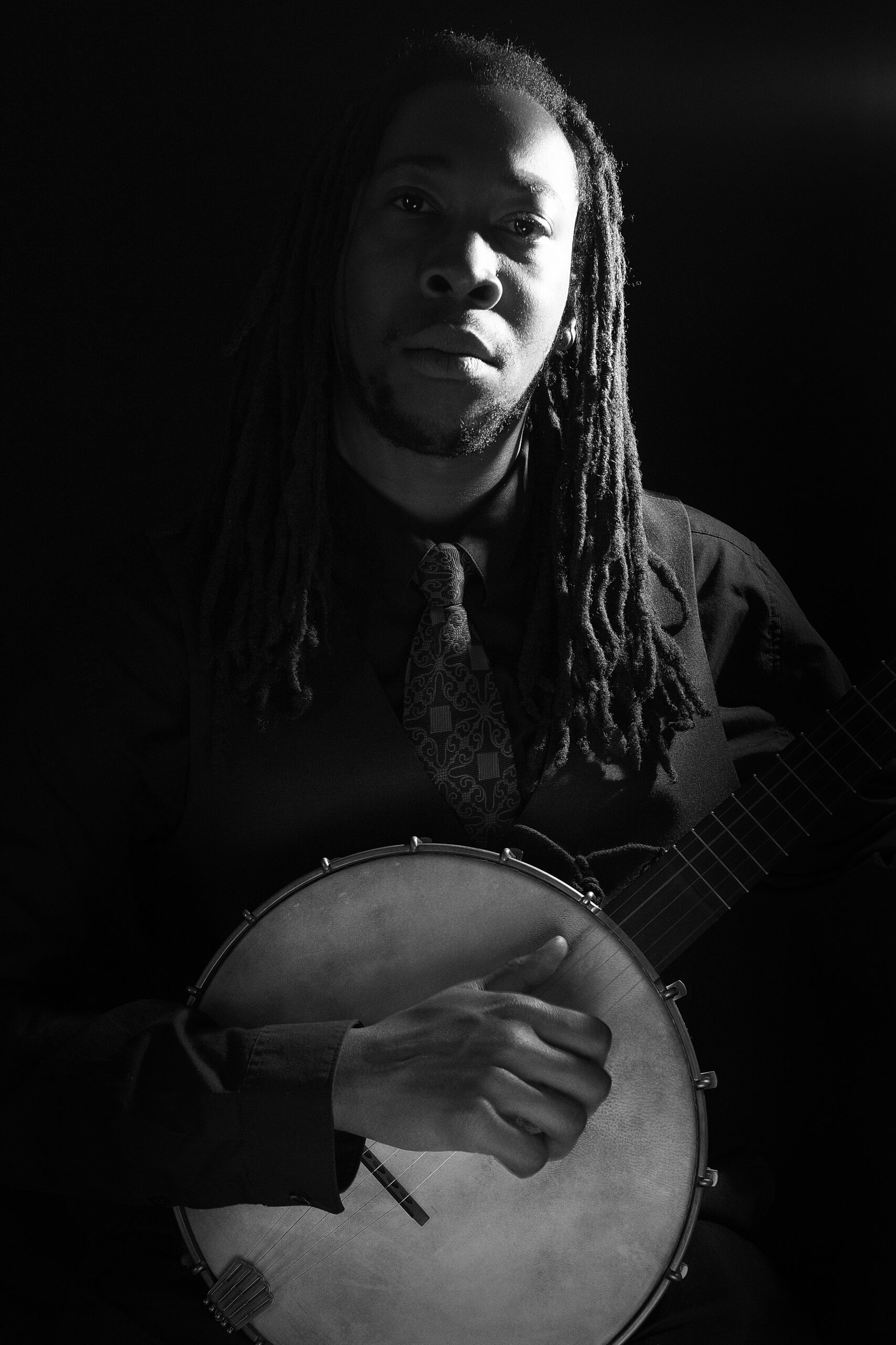
Hubby Jenkins, the multi-instrumentalist interpreter who achieved popularity as a member of the Carolina Chocolate Drops and as a member of Rhiannon Giddens and the Old-Time Review band, has in the last decade established himself as a virtuoso solo performer and archivist of old-time music. His appearances are rich with stylistic exploration of numerous artists across the wealth of the old-time catalog, and, in his capacity as a historian and a warm and charismatic raconteur, he includes amazing stories and educational tangents focusing on the Black experience through his own distinctive prism.
He’s released two recordings, the full-length “Hubby Jenkins” (2016) and, “The Fourth Day” (2020), the latter of which is an amazing EP of creative interpretations of Deep South Black spirituals. On Nov. 14, Jenkins appears in the up-close-and-personal Oasis Room of New London’s Garde Arts Center.
It’s a reminder of the astounding opportunity to see an artist of this magnitude with a living-room style of intimacy.
Shortly before Halloween, we spoke with Jenkins by phone from New Orleans. He’s a friendly, erudite and resolutely optimistic conversationalist who promised to do his best to send us a muffaletta. NOTE: This interview took place before the midterm elections. Responses have been edited for space and clarity.
The Garde: I’m intrigued by the categorization of Old Time music. And given the state of the music industry and the perhaps banal appetite of the average music consumer, define for us the parameters of Old Time music.
Hubby Jenkins: Sure. My definition is pre-World War II traditional American music — or Old Time music. For me, this would include all the music that became the music we love today. It’s music that is pre-jazz, that is pre-country, that is pre-soul, rap, funk, pre-rock — all of these things is found today in American music. So Old Time music for me encompasses all of this and crosses state lines, color lines, et cetera, et cetera.
Garde: For those who might not be familiar with your music, or maybe only know you from your time in the Carolina Chocolate Drops or subsequent work in Rhiannon Giddens’ band, what can folks expect when they see your solo show in the Garde’s Oasis Room?
Hubby: Basically, what I do is play old-time music and talk about Black people. And one of the main pillars of Carolina Chocolate Drops was sharing information, for example, about the banjo specifically being a Black instrument, and talking about Black contributions to American music.
And I guess my personal shows or my solo shows riff off that. But I also talk a lot about using the music to tell stories about Black history and the Black experience. So, I can talk about the creation of the banjo and why we don’t associate it in the context we used to.
(Laughs) And I can sing dirty songs and talk about Black sexuality, and we can sing gospel songs and talk about the creation of black Christianity and what it all means. So, you know it’s kind of a mixture of all those things.
Garde: Speaking of Black Christianity, your most recent recording is “The Fourth Day,” an EP of old-time spiritual tunes performed with an astonishing since of period authenticity fused with your own emotions and dexterity. It includes the passed-down oral tradition song “How About You?,” the Blind Wille Johnson-associated “I Know His Blood Can Make Me Whole,” “Jonah in the Wilderness” by Henry Thomas and “I Must be Blind, I Cannot See” by Blind Roger Hays.
Two things: The relative obscurity of the material suggests not only your scholarship but, to extrapolate, how hard was it, given the large amount of old-time gospel music that relatively few listeners are aware of, for you to select the songs for a recording?
For that matter, whether gospel music or the larger old-time repertoire across genre or instrumentation, how wide ranging is your touring repertoire in general?
Hubby (laughs): Oh yeah. Um, I don’t know, I like to listen to music a lot. If I’m on a good day, like I try to listen to like one new album a day. With no skipping and no playlists; I just want to hear an album, front to back. In the context of the EP, it’s just an example of what I might be exploring at a certain point. A lot of times, I’ll get into listening to a certain style and I’ll think, right now, I want to do more gospel music. I want to do more Christian music and I want to start talking about like black Christianity. You know, what does that mean?
Where did it come from and how did it evolve? So, I came up with that concept of Black Christianity in its roots and naturally started listening to a lot of Christian music where my immediate sources might be labels like Document Records, Smithsonian Folkways and Yazoo R — and then I just keep expanding from there.
Garde: And that leads to more research into the contextual history?
Hubby: Right! I might be reading a book that talks about, for example, life in Virginia when they decided that Black people will be enslaved forever — but they also said they wouldn’t enslave Black people if they’re Christian, right?
And that caused the first big wave of Christianity among Black folks in the Americas, right? So that made me think of “Jonah in the Wilderness,” right? A song where God’s looking for someone to preach his Word very reluctantly. You know, and these two components can go together now, you know? So that’s a long explanation, but it’s kind of how I pick my songs based around what I want to talk about historically or storytelling-wise.
Then, of course, I want to share with the audience just whatever I find fun or interesting to play. That’s a big part of the music, right?
Garde: I’m looking forward very much to the storytelling aspect of your show at the Garde. My wife and I have lived in Connecticut for almost thirty years now, but we did grow up in the south. It makes me curious: When you’re talking about things like black Christianity or the evolution of Black music that predates what a lot of people think of as white innovation, do you alter what you might say or how you would say it in a blue state like Connecticut as opposed to if you were in Mississippi or something?
Hubby: That’s a great question. I try not to. Um, there are some things that, when I was developing the gospel stuff for performance, there were critiques of Christianity that were very difficult for people. And I will admit that I cut them from my shows.
But other than that, you know, what you get is pretty much what I believe and who I am. So far, that hasn’t caused too much trouble. In the last year or so, you know, Part Two of Trump, I’ve had more colleges and certain venues ask for more pre-information before I show up. You know: Like, what exactly are you going to be talking about? Can we have an outline, please? Stuff like that?
That’s been kind of new, but for the most part, people know what they’re getting with the Hubby Jenkins show. I will say, during the first Trump administration, that was a rough time. People were writing me angry emails and, you know, once or twice people would leave shows. But I’m okay with all that.
Garde: Speaking of the American political climate of the last ten years, I read a quote of yours from 2016. You were describing the cultural realities that were part of life for old-time artists in the 1920s and 30s and how society has changed since then. And with regards to your hopes and anticipation moving forward, you said something like, “Well, let’s see how it goes with Trump. I might move to Berlin.”
So, depending on how things go with the midterms, A) can I go with you to Berlin?, and B) we’re a decade down the road from when you said that. What do you observe today, when you’re on the road and in performance and meeting people reacting to your performances, about how our political and cultural climate has have changed over those years?
Hubby: Yeah, you know, first I would say I may have changed my opinion about leaving for Berlin. I was indeed thinking about Berlin, but then I decided to make it Benin since now they give citizenship to people from the diaspora.
But then, pretty recently, I decided that I’m NOT leaving, you know? And that’s centered on the idea that like, you know, WE built this. You know, my ancestors built this thing. This is pretty much mine anyway, you know?
And when I think about fascists and white supremacists and the people who are in power now — and how much they hate this country and how much they want to change it — I think THEY should be the ones who should need to leave since they don’t like it as much. But anyway, that’s not exactly what you asked me.
You asked me about how things have changed from my perspective through what I’ve observed doing what I do. In that time, you know, Black and POC and queer representation in Americana music, and a traditional music, which is what I play, has blown up. It’s really exploded and has allowed all these different ideologies and points of view and things to get into this music and to be heard again.
I think of a lot of what we do as resistance music, and the function of the music is returning to not just bringing joy but also having a message and being a haven from, you know, homogenized pop mediocrity and complacency. Plus, what we’re playing is music that can be made by anyone, for everyone. I’m just happy to be part of that.
Garde: Acknowledging your virtuosity on a lot of instruments, I’m fascinated by how well you assimilate and the nuances and peculiarities of so many country blues guitarists such as Skip James, Bukka White or Mississippi John Hurt, just to name a few. At first you just liked the work and then started playing it. At what point did you realize there was a lot individual technique and tunings and so forth — and there would be a lot of musical homework?
Hubby: Do you mean “homework” like a chore, or how much work it would take to learn it? You know, when I first started getting into this music, I was on a year off from college — and I’m still in that year off! (laughs) And for me, it was the realization that I wanted to play music but I didn’t really know what it was yet.
And so I was playing electric bass and hanging out with friends and — I’m going to age myself here — but luckily one of my friends had a dad who is a record collector. What happened is, for example, Bob Dylan’s first album had “Fixin’ to Die” by Bukka White on it. I was like, “Who’s Bukka White?”
And I was able to go to my friend dad’s house and find a Bukka White record and dig into it in that way. I also had this group of friends, and we were kind of getting into this traditional music. We’re learning about Harry Smith and the great folk revival of the 1950s and ’60s — McDougall Street and the West Village.
So, long answer to your question: It didn’t really feel like homework. It was just like what I did. I woke up every day. I drank a pot of coffee, I’d smoke a pack of cigarettes and listen to Skip James over and over again until I figured out two seconds of one song, and then I’d go busk or go to work and do it all again. You know, that was my life.
Garde: Maybe “homework” wasn’t the best word choice.
Hubby: (laughs) Well, maybe because I never went to school for something like this, I never thought of it as homework. It just IS. So I guess it’s how you consume it, right? There’s this oral tradition. It’s this auditory experience, and the way I learned was by training my ears and then having encounters with older musicians or other musicians who would teach me things here or there. I think it’s, um, just immersing yourself in the art or, I don’t know, living the art, or consuming the art, breathing the art — and breathing it means inhaling and exhaling. So, I guess when I play, I’m just exhaling these things that I’ve just been consuming.
Garde: I think most passionate artists go through similar experiences. I was curious, though, about the nuances of learning different guitar styles. I was thinking, you know, so many of these guys sort of invented their own open tunings and finger picking styles and to master the subtleties and there was a lot of distinctive and intricate stuff going on for someone trying to learn.
Hubby: I see what you’re saying. Oh yeah, for sure. I mean, and there are always these little discoveries, you know, I don’t know. I just remember the day that, like, I learned Reverend Gary Davis only played with his thumb and his first finger, you know? I was like, oh, what does that mean? How does this roll work? I mean, what does it mean? (EDITOR’S NOTE: The “Davis Roll” is a precise picking pattern alternating between the thumb and index finger.)
Or when I learned there was a video of Bukka White playing! I was like, “Oh, NOW that makes sense. That’s why he sounds like that on the record, you know? It’s constant discovery and constant learning.
Garde: Is there a point where getting it exactly right becomes sort of counterproductive to the spirit of the whole thing?
Hubby: You know, when I first started playing, it was very much like, “I want to sound exactly like these people. Lick for lick. I’ll play the mistake on the record. And show people how faithful I can be.
Then I started hanging out with people, specifically like (fiddler) Peter Stampfel of the Holy Modal Rounders and (multi-instrumentalist) John Cohen of New Lost City Ramblers, and they really taught me to do my own thing with it, right? These are two traditional artists who play traditional music — but differently. They’re not songwriters or anything like that, but they, you know, encyclopedias for this music.
Garde: In that context, and on your own releases, you typically don’t write your own material but explore old-time music. I’d call you an interpreter.
Hubby: Exactly. And so it became about interpreting through muscle memory and brain power. I had to be able to learn these things, lick for lick, and also absorbing these amazing little intricacies and little differences in their playing — whether it be specific artists who developed it, or even regional things like tunings and stuff like that. And then it all becomes what you have at your disposal, you know?
I remember hearing a story about a fiddler. He described going to dances, and, you know, hearing a song that he liked, then he’d have to whistle it all the way home just to remember it. When he got home, he would just play what he whistled and also what he didn’t remember and, you know, suddenly we’ve got a new tune. And so I always think about that.
Garde: Would you ever — or do you ever — (and I’m just throwing out names here) apply a Blind Lemon Jefferson trick or technique to a Reverend Gary Davis song?
Hubby: Hmm. Interesting. If I do, it’d be very subconscious, you know? I haven’t thought to do mashups like that! Although that would be a funny record, right? “Hubby Jenkins plays Bukka White plays Mississippi John Hurt.”
Garde: It was just a thought.
Hubby: No, it’s an idea that I’d think about! You know, like last night, I was jamming with some people here and playing songs I usually play on the mandolin. I was playing them on the banjo. And so like, you know, the banjo knowledge that is in me comes out to fill in these blanks there. So I was definitely doing like some (old -time banjoists) Doc Boggs and Uncle Dave stuff to go with like (old-time Black string band) Dallas Rag tunes, you know? So stuff like that will happen and that becomes more like a necessity thing than an active exercise in creativity.
Garde: Can you describe any particular epiphanic moment in your ongoing musical education?
Hubby: I guess I had a few moments like that. I grew up with the internet, I guess, but around the time that I was getting into this music, I didn’t use the internet like that. We didn’t have smartphones yet and I didn’t have a computer.
So everything that I learned, I learned from people and books and liner notes. And I think one of my big moments was reading a book called “Ragged But Right — Black Travelling Shows, ‘Coon Songs” & the Dark Pathway to Blues and Jazz.” It’s kind of a dry book, but it is actually really interesting.
But at some point, it just casually mentions that the banjo is a black instrument. Wait a minute! I thought, “The banjo is a BLACK instrument?” And I was on my way. I thought, “You know, I’ve been skipping all the banjo tracks on this Harry Smith anthology for a year now, you know, you know, not finding any connection; not finding any interest there.”
And once I’d opened up to that idea, suddenly this picture makes sense, you know? Now, you know, early jazz makes sense. Preservation Hall makes sense now.
And so that was like an open-the-door moment for me to make all these connections about what Black music was and what the Black influence was on our music and how connected it all was.
Oh, and I’ll just add to one more epiphanic moment, too. I remember one time busking in Union Square, and some guy came up to me, he said, “Wow, boy, I’d never seen a Black boy play bluegrass like that before.” And meanwhile, I’m 20 years old — but I’m playing Robert Johnson on guitar, you know?
And I was like, “There’s so much wrong with your sentence. I don’t even know what to say, you know?”
And that kind of set me on this educational thing. I want to inform people, you know? I want people to know these things. I feel like when I joined up with Chocolate Drops, it’s like Rhiannon Giddens and Dom Flemons and I could all connect to what it was like being Black and going into these white spaces. We HAD to know this history and the roots and like where it all comes from in order to represent and to validate, in some ways, our existence in those environments. So it becomes like second nature — and not necessarily work but, as I call it, part of playing this music as a person.
Garde: To follow up with that, the Chocolate Drops became a highly respected and popular band. Y’all won a Grammy, made the Billboard charts and were big draws on a wide festival circuit. So you were clearly making an impression for musical reasons and cultural reasons.
Hubby: When we go back to like the definition of what old-time and traditional music is, I think one of the things that was enduring about Chocolate Drops music is that we played all these different traditions and put them under the same umbrella. You might come to a show and like, it would be, here’s a tune by (old-time blues singer) Ethel Waters, followed by traditional North Carolina fiddle tune, followed by Irish lilting, with uh, fife and drum bassline behind. You know what I mean? Like, it was all these sorts of things. I think that allowed us to fit in with a lot of different genres, and we could play at a variety of festivals and maybe open some eyes and ears.
Garde: I will close with this variation of a tired, but admittedly fascinating question a lot of artists get. I’m not going to ask you which three guests you’d have at your fantasy dinner party. Instead, if you could go on tour as part of a band with any three artists from music history, living or dead, who would they be?
Hubby: Oooh, this is really good. Okay. I think … I think I know who they’d be. I take Bessie Smith on vocals, James Jamerson on bass — and I think I want Sly Stone on keys.